By: Minjoo Jung
Published: May 1, 2022
Got in trouble? Did I do Wrong?
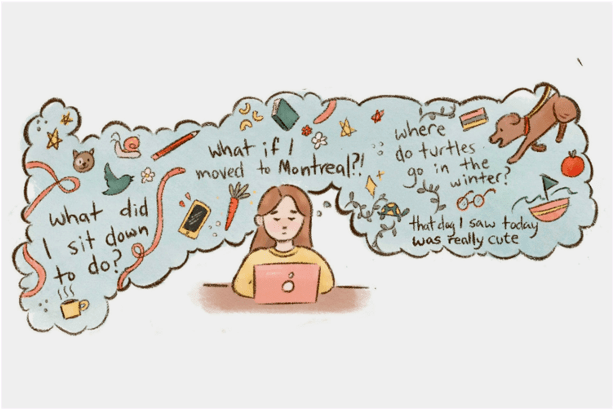
ILLUSTRATION BY GABRIELLE DROLET (2022)“Get down from there!!!”
“Stop yelling!”
“Why did you fail your test? You know this material!”
Have you ever felt like your child is crazy for not being able to stay in one place not even for 2 seconds?!?
Well before you stress yourself and ground your child, lets take a step back and look at the patterns.
First, I would like to introduce Attention Deficit Hyperactivity Disorder (ADHD), which is a neurodevelopment diagnosis, where the symptoms have an onset prior to 12 years of age and presented in at least two settings. According to AATBS (2020), in ADHD there are two characteristics which are inattention and/ or hyperactivity and impulsivity. They have couple symptoms under them and if one is to have 6 (or more) symptoms from either inattention or hyperactivity and impulsivity, for at least 6 months, interfering with development level and negatively impacting social and academic activities, they should get tested for ADHD.
Following are the symptoms:
Inattention
• Fail to give attention to detail and making careless mistakes during important activities
• Fail to focus
• Seems to not listen when spoken to because of distractions
• Gets distracted easily causing negative in tasks that may be for work or school
• Messy and disorganized
• Avoids dislikes
• Misplaces things a lot of the time
• Easily distracted by extraneous stimuli
• Often forgetful
Hyperactivity and impulsivity
• Fidgets a lot
• Leaves seat when being seated is expected
• Runs and climbs in inappropriate occasions
• Unable to engage quietly when its leisure
• Feeling uncomfortable to stay still
• Talks excessively
• Blurts answers
• Difficulty waiting for their turn
• Interrupts or intrudes others
Causes of ADHD
I understand as a mother of two, why parents can blame themselves for their kids to be diagnosed with ANYTHING. However, we as parents need to understand not to blame anyone. ADHD is founded among biological relatives than general populations. It is a higher concordance rate for identical than fraternal twins. Also, linked to certain brain abnormalities. ADHD is neurological, therefore, instead of thinking about the causes let’s focus on the solution.
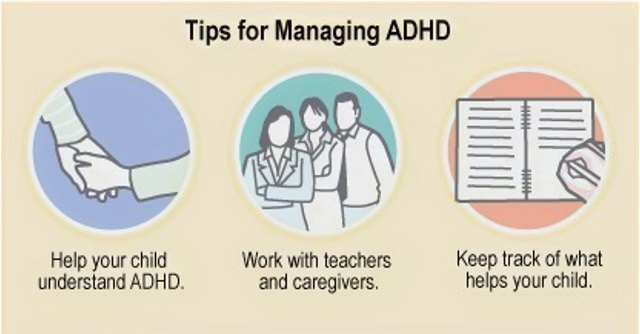
Treatment for ADHD and things parents/families can do to help their child…
Let’s say your child is going through behavioral problems. Think about what your normal reaction towards this usually are.
Okay, now lets take a step back and think about this again, but this time knowing that your child has ADHD. What would you do different? In most cases parents do not know what to do. However, according to Thompson et al., (2017), it is best for parents to use ‘positive’ or ‘gentle’ reasonings to increase the child’s compliance. I mean think about it and put yourself in their shoes. Imagine you mess up and your parents yell at you or ground you for something you don’t even know the reason for, would you understand them or are you going to stomp your way back to your room? ADHD are consisted of several parts when parents lack social and educational resources to cope with and manage the child’s difficult and challenging behaviors (Larson et al., 2014, as cited in, Thompson et al., 2017). It is important for the parents to adopt to the child. Reasoning with your child is more effective and it enhances the child’s sensitivity to the feelings and need to others. You can also play games with your kids and address ADHD related neurocognitive deficit, targeting attention skills. Thompson et al., (2017), did a research paper on ‘Adapting an ADHD Parent Training Intervention to Different Cultural Contexts’ and mentions the New Forest Parenting Program (NFPP).
NFPP treatment targets:
• Improving parents understanding of ADHD
• Increases parents readiness and capacity for change
• Restructures parents attributions about ADHD
• Enhances the emotional relationships between the parent and child
• Create an effective working relationship between parents and child
• Scaffolding principles
• Parents encourage is the child to choose positive behavioral choices over unwanted ones
• Generalizing parens NFPP methods
• Sustaining the use of NFPP even after formal program has ended
Medication
It is best to consult with a professional like your kids pediatrician or a family doctor.
Medications are frowned upon from many parents however, sometimes ADHD can be very extreme. Therefore, it is important to talk to the providers to make sure the treatment plan is successful. Larry Silver (2022), talks about stimulants and non stimulants as medication for ADHD. Stimulants are considered first line treatment and there are drugs like amphetamines and methylphenidate that falls under this category. Examples of non stimulants are atomoxetine, guanfacine, and clonidine, which are used by patients who do not tolerate or see benefits from the stimulant medications (Silver, 2022). For more information on this I would recommend reading ‘ADHD Medication Options: Stimulants, Non-stimulants & More’ https://www.additudemag.com/adhd-medication-for-adults-and-children/ by Larry Silver, M.D. Not only does he talk about the different drug types, but he also breaks down the meaning of stimulants, non-stimulants, how the medications are dosed, and side effects.
Cultural Considerations
Culture plays a big role on how the parents react to kids with ADHD. My nationality is Korean and I remember if I was to yell while playing, my family would get mad and tell me I am not being lady like or that I am acting like a crazy person. Now remind you I do not have ADHD, so imagine if I did, I think I would have gotten spanked everyday.
Using the NFPP, researched by Thompson et al., (2017), talks about educating parents and help them develop a more positive relationship, learning to manage children’s behavior. This will help children self-regulate their own behaviors. NFPP also helps parents build competencies and confidence by offering behavioral strategies and skills. NFPP is reliable in different cultures because it was tested and researched in Western cultures indicating positive changes in ADHD symptoms. Many interventions are presented with different cultures. For example, in Denmark, praises to children are not very common and psychologists are not well educated in behavioral therapy. In Hong Kong, parents are more controlling over their children and strict. However, NFPP was helpful for these cultures because it is tailored to the needs of parents and it is flexible for different cultures as well. The goal is to not change the culture but to help your kids cope with ADHD. It is important to implement NFPP in a culturally appropriate way.
Now my goal was for you to understand that reacting negatively with kids that have ADHD will not help them at all. Being able to use NFPP and being able to motivates your child in a positive attitude will help them better understand their behaviors. I hope my insight and resources provided to you guys can help improve your relationship with your child 🙂
References
Association for Advance Training in the Behavioral Sciences (Ed.). (2020). Marriage and Family Therapy National Licensing Exam Prep (MFT), 2020 (1st ed.). AATBS. American Psychiatric Association (Ed.). (2013). DSM-5: Neurodevelopmental Disorders. In Diagnostic and statistical manual of mental disorders (5th ed.). Arlington, VA: American Psychiatric Association. Kidshealth. (2020, June). [Image]. https://kidshealth.org/en/parents/adhd.html
Silver, L. (2022, March 15). ADHD medications for adults and children: ADD stimulants, Nonstimulants & more. ADDitude. https://www.additudemag.com/adhd-medication-for-adults-and-children/
Thompson, M.J.J., Au, A., Laver‐Bradbury, C., Lange, A.‐M., Tripp, G., Shimabukuro, S., Zhang, J.S., Shuai, L., Thompson, C.E., Daley, D., & Sonuga‐Barke, E. J. (2017). Adapting an attention‐deficit hyperactivity disorder parent training intervention to different cultural contexts: The experience of implementing the New Forest Parenting Programme in China, Denmark, Hong Kong, Japan, and the United Kingdom. Psych Journal, 6, 83-97. Understanding ADHD. (2021, February 3). [Image]. OpenLearn. https://www.open.edu/openlearn/health-sports-psychology/understanding-adhd/content-section-0?active-tab=description-tab

 Enjoy the mind and heart